From Wi-Fi 4 till Wi-Fi 8: The various Wi-Fi standards explained

Updatet on July 28, 2026
November 30, 2025 - For more than 20 years, Wi-Fi has changed the way the world operates and communicates. Wi-Fi technology is based on the 802.11 wireless communication standard developed by the Institute of Electrical and Electronics Engineers (IEEE). Over the past 20 years, many improvements have been made to the 802.11 standard. Each generation brought higher throughput speeds, lower latency, and better user experiences. To make it easy to distinguish between all Wi-Fi standards, the Wi-Fi Alliance decided to give all Wi-Fi standards a simple name. We also want to provide you with an overview of the Wi-Fi standards. Therefore, we list all standards on this page, from the most recent to the oldest, so that you can make an informed choice to find the right access point for your network.
Wi-Fi 8 (802.11bn)
While Wi-Fi 7 was mainly focused on higher speeds, Wi-Fi 8 is all about more stable connections, stronger coverage, and smoother roaming. They achieve this in part through Distributed RU (DRU). This technology makes it possible to reach lower-power devices that are further away—such as a mobile phone—by increasing the total transmit power. ELR, or Enhanced Long Range, serves a similar purpose: improving coverage at the edges of your network. Both technologies make it possible to reach more devices over a larger area.
Multi-AP Coordination, another unique feature of Wi-Fi 8, ensures that different Access Points in a single environment are better synchronized with each other. With Coordinated Beamforming (Co-BF) and Coordinated Spatial Reuse (Co-SR), for example, you ensure that devices don't fall under the overlapping coverage of multiple Access Points; instead, Access Points intelligently divide their signal among the connected devices. AP 1 reaches device 1, and AP 2 reaches device 2. Check out the article from our partner Omada for more information on all these technologies.
Wi-Fi 7 (802.11be)
The next Wi-Fi generation is Wi-Fi 7. The standard is called 802.11be. Users of the new generation have access to a new frequency band, 6 GHz—just like when using Wi-Fi 6E. In both Wi-Fi 6E and Wi-Fi 7, 500 MHz of bandwidth has become available on the 6 GHz band. This is equal to 25 channels of 20 MHz that can be bonded to a maximum width of 320 MHz.
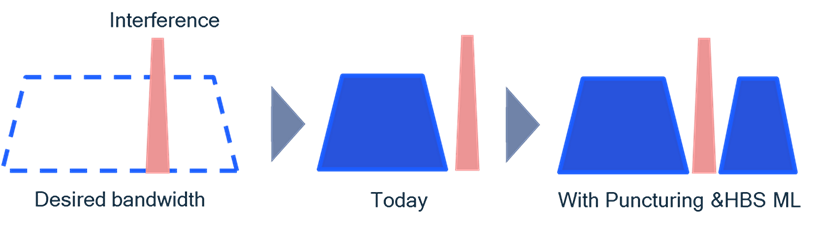
Wi-Fi 7 also introduces High-Band Simultaneous Multi-Link. This means that two Wi-Fi radios can operate simultaneously in the 5 GHz band or the 6 GHz band, creating one aggregated data pipe. The result is a significant increase in data speed and lower latency during link congestion. Another new technology is preamble puncturing. This means that devices can benefit not only from the spectrum up to the point where interference occurs, but also from the spectrum beyond the interference. Qualcomm has created a handy diagram for this:
Wi-Fi 6 (802.11ax)
The latest generation of Wi-Fi equipment is based on the 802.11ax standard. This standard is also known as Wi-Fi 6. Wi-Fi 6 was introduced in 2019 and, in addition to higher speeds, offers many more advantages over the older Wi-Fi 5. Wi-Fi 6 provides an improvement in capacity, efficiency, coverage, and performance to provide challenging environments with a good Wi-Fi connection. The standard is extremely suitable for ultra high-density environments where hundreds or thousands of devices are seeking connection, but also provides benefits for smaller business networks.
Just like Wi-Fi 5, Wi-Fi 6 operates on both the 2.4 GHz and 5 GHz frequencies. Wi-Fi 5 innovated on the 5 GHz band. Wi-Fi 6 innovates on both the 2.4 GHz band and the 5 GHz band. As a result, the speed and range are higher than those of single-band access points. On the 2.4 GHz band, a greater range can be achieved, while on the 5 GHz band, a higher speed can be attained. Users with Wi-Fi 6 access points thus benefit from both advantages.
Wi-Fi 6E
If the manufacturer indicates that the hardware supports Wi-Fi 6E, the device can use the 6 GHz frequency band. This results in an even higher speed. In June 2021, the use of 5945 MHz to 6425 MHz for Wi-Fi 6E was approved by the European Commission.
Modern networks based on Wi-Fi 6E and Wi-Fi 7 use the 6 GHz band. Where interference limits the 5 GHz band to a maximum of two wide 160 MHz channels, the lower 6 GHz band in the EU adds three 160 MHz channels within the available 480 MHz. With the emergence of Wi-Fi 7, 320 MHz channels are even possible, although in practice only one fits in the current European band.
Yet, the EU is lagging behind in this area compared to other regions. While the United States, Canada, Chile, Costa Rica, South Korea, and Saudi Arabia have released the full 6 GHz band (1200 MHz), only half is currently available in Europe. With full allocation of the 1200 MHz, as many as seven 160 MHz channels or three 320 MHz channels could operate side-by-side, resulting in significantly less interference and even higher performance.
Innovations Wi-Fi 6
- Uplink and downlink Multiple User - Multiple Input Multiple Output (MU-MIMO): This increases the throughput speed of the access points.
- OFDMA: Increases network capacity by splitting channels. This makes it possible to send data from one user through one part of the channel while the remaining parts remain available for other users. This also reduces interference.
- Increase of QAM to 1024 QAM: Which increases the throughput speed by 25% compared to a Wi-Fi 5 access point.
- Spatial frequency reuse: Ensures that performance in busy areas improves.
- Target wake time: Tells the device when to put the access point to sleep and when to receive the next transmission. This reduces energy consumption.
- Introduction of WPA3: WPA3 features higher encryption than WPA2, mandatory support for protected management frames, and OWE support. The latter means that encryption can be applied to connections for public hotspots and networks without a network key.
Wi-Fi 5 (802.11ac)
Wi-Fi 5 was introduced in two phases. The first phase was made available by the IEEE in 2014 with 802.11ac Wave 1. 802.11ac Wave 1 made use of multiple channels, allowing more bandwidth to be offered. As a result, the maximum throughput speed of Wi-Fi 5 is higher than that of Wi-Fi 4. 2015 brought the second phase: 802.11ac Wave 2. With this introduction, Multi-User MIMO, among other things, became available. Both the Wi-Fi 5 access points that use Wave 1 technology and the access points that use Wave 2 technology deliver speeds up to several multi-gigabits per second. These improvements work exclusively on the 5 GHz frequency band.
Despite this, most Wi-Fi 5 access points are dual-band. For the 2.4 GHz frequency band, these access points use the innovations of the Wi-Fi 4 standard. As a result, Wi-Fi 5 access points can achieve lower speeds on the 2.4 GHz band, while high throughput speeds can be achieved on the 5 GHz frequency band. Due to these higher throughput speeds, Wi-Fi 5 devices can support demanding applications such as Ultra HD and 4K video, multimedia streaming, and fast file transfers on tablets, game consoles, handsets, and many other devices.
Innovations Wi-Fi 5
- Doubling of spatial streams to 8.
- The 20 MHz channels can be bonded up to 160 MHz. On Wi-Fi 4, only 80 MHz was possible.
- QAM modulation increased from 64 QAM to 256 QAM.
- Standardized Beamforming.
- From Wi-Fi 5 Wave 2 onwards, access points feature downlink MU-MIMO.
Wi-Fi 4 (802.11n)
In 2009, the IEEE presented their newest standard: 802.11n. This standard was later called Wi-Fi 4. Wi-Fi 4 can make use of both the 2.4 GHz and the 5 GHz frequency bands. In practice, however, we see that many Wi-Fi 4 access points are single-band, where the manufacturer chooses between using the 2.4 or 5 GHz frequency band. Wi-Fi 4 access points deliver theoretical throughput speeds up to 600 Mbps, thereby providing sufficient bandwidth for applications such as browsing the Internet. Furthermore, many of the current IoT devices make use of Wi-Fi 4 and Wi-Fi 5.
Innovations Wi-Fi 4
- Concurrent spatial streams increased to 4.
- This is the first standard where channel bonding is possible and the potential channel width has been doubled from 20 MHz to 40 MHz.
- Supports dual-band application on both the 2.4 GHz frequency band and the 5 GHz frequency band.
802.11g
In 2003, 802.11g was officially made available for use. Like 802.11b, 802.11g exclusively uses the 2.4 GHz frequency band. Nevertheless, this standard could achieve higher speeds than 802.11b. This has to do with the difference in the modulation technique. Specifically, 802.11g uses QAM modulation.
802.11a
802.11a succeeded 802.11b in the same year. This was the first Wi-Fi standard to use the 5 GHz frequency band. Moreover, this standard used QAM modulation for the first time.
802.11b
802.11b was the first major improvement to the original Wi-Fi standard. This improvement was especially noticeable in the higher throughput speed of up to 11 Mbps. The modulation was also different.
In the table below, the differences between the Wi-Fi standards are clearly summarized:
| 802.11 | 802.11b | 802.11a | 802.11g | 802.11n | 802.11ac | 802.11ax | 802.11be | |
| Year Ratified | 1997 | 1999 | 1999 | 2003 | 2009 | 2014 | 2019 | 2023 |
| Operating Band | 2.4 GHz/IR | 2.4 GHz | 5 GHz | 2.4 GHz | 2.4 & 5 GHz | 5 GHz | 2.4-, 5- & 6 GHz | 2.4-, 5- & 6 GHz |
| Channel Bandwidth | 20 MHz | 20 MHz | 20 MHz | 20 MHz | 20/40 MHz | 20/40/80/160 MHz | 20/40/80/160 MHz | 20/40/80/160/320 MHz |
| Peak PHY Rate | 2 Mbps | 11 Mbps | 54 Mbps | 54 Mbps | 600 Mbps | 6.8 Gbps | 10 Gbps | 46.1 Gbps |
| Aggregate MIMO Spectral Efficiency | 0.1 bps/Hz | 0.55 bps/Hz | 2.7 bps/Hz | 2.7 bps/Hz | 15 bps/Hz | 42.5 bps/Hz | 62.5 bps/Hz | 144.06 bps/Hz |
| Max # SU Streams | 1 | 1 | 1 | 1 | 4 | 8 | 8 | 16 |
| Max # MU Users | NA | NA
|
NA | NA | NA | 4 (DL only) | 8 (UL & DL) | 16 |
| Modulation | DSSS, FHSS | DSSS, CCK | OFDM | OFDM | OFDM | OFDM | OFDM, OFDMA | OFDM, OFDMA |
| Max Constellation/ Code Rate | DQPSK | CCK | 64-QAM, 3/4 | 64-QAM, 3/4 | 64-QAM, 5/4 | 256-QAM, 5/6 | 1024-QAM, 5/6 | 4096-QAM, 3/4 OF 5/6 |
| Max # OFDM tones | NA | NA | 64 | 64 | 128 | 512 | 2048 | 4096 |
| Subcarrier Spacing | NA | NA | 312.5 kHz | 312.5 kHz | 312.5 kHz | 312.5 kHz | 78.125 kHz | 78.125 kHz |
Display prices in:EUR